
by Richard Cull
July Market Recap and Commentary
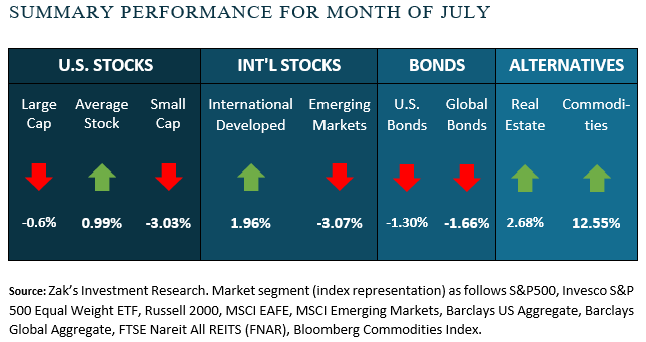
Commentary
July served as a reminder that while one source of uncertainty may fade, new challenges are never far behind. Equity markets experienced meaningful volatility throughout the month before finishing little changed, while fixed income markets declined as interest rates remained elevated. Although the U.S.-Iran truce announced in June initially reduced one of the year's largest geopolitical risks, renewed tensions and a series of new economic concerns—including tariffs, government borrowing, and questions surrounding artificial intelligence spending—left investors searching for direction.
Economic data released during July provided several encouraging signs that inflationary pressures may finally be beginning to ease. The Consumer Price Index posted its first monthly decline since the onset of the COVID-19 pandemic, while core inflation continued to moderate and the Producer Price Index also came in below expectations. Falling energy prices, following the June cease-fire between the United States and Iran, contributed to the improvement, while the labor market remained resilient with employers adding 172,000 jobs in June—well above expectations—and the unemployment rate holding steady at 4.3%. Taken together, the data suggested the economy continued to expand while inflation showed tentative signs of moving back toward the Federal Reserve's long-term target.
Despite the encouraging economic data, investors found no shortage of new concerns. Treasury yields remained elevated throughout the month as markets continued to weigh the implications of persistent federal budget deficits and the prospect of increased government borrowing. At the same time, the technology sector experienced increased volatility as investors began questioning whether the extraordinary capital expenditures being made by many of the largest technology companies would ultimately generate returns sufficient to justify their valuations. The reemergence of tariff concerns and renewed tensions surrounding Iran further contributed to an environment where improving fundamentals were often overshadowed by uncertainty about the future.
The Federal Reserve also found itself navigating this increasingly complex environment. While signs of moderating inflation were encouraging, policymakers remained cautious as they assessed the potential impact of tariffs, persistent government borrowing, and geopolitical uncertainty on the inflation outlook. Chairman Kevin Walsh continued to emphasize a data-dependent approach, recognizing that a single month of improving inflation data is unlikely to establish a lasting trend. For investors, the message remained clear: although progress has been made, monetary policy is likely to remain focused on balancing inflation risks against an economy that continues to demonstrate surprising resilience.
The past five months have provided a valuable reminder that financial markets are constantly evolving as new information becomes available. In March, investors focused on the risks of a broader Middle East conflict. By April, those fears began to subside, shifting attention toward inflation and rising interest rates in May. June brought renewed optimism as geopolitical tensions eased and inflation showed early signs of moderating. By July, however, investors were already evaluating an entirely new set of risks, from government borrowing and tariffs to questions surrounding artificial intelligence spending. This progression illustrates that markets rarely wait for certainty. Instead, they continually reassess future expectations, often moving well before economic headlines or consensus opinion. For long-term investors, understanding this process reinforces the importance of maintaining discipline and focusing on enduring fundamentals rather than reacting to each new source of uncertainty.
Risk Numbers
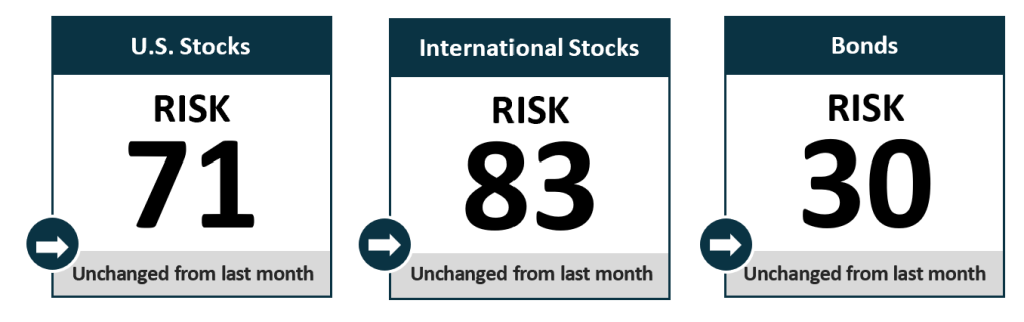
As of 08/05/2026
The Risk Number is at the heart of a sophisticated set of tools to precisely measure the appetite and capacity for risk that each client has and demonstrate their alignment with the portfolios built for them. The following graphic shows the risk of various asset classes as measured on a scale of 1-99 (1 being the most conservative and 99 being the most aggressive) as of the date above.
Centric's Approach
We start with a Risk Number, a measurable way to pinpoint how much risk you want, need, and already have. Then, your wealth advisor will optimally allocate our investments to help you reach your financial goals. Along the way, you will receive transparency of information, seamless proactive service and the trust and accountability you need to stay on track. All of this will lead to your personal comprehensive investment strategy that is powerful, disciplined, responsive.
Sources:
Centric’s Market Assumption Disclosures: This information is not intended as a recommendation to invest in any particular asset class or strategy or product or as a promise of future performance. Note that these asset class assumptions are passive, and do not consider the impact of active management. All estimates in this document are in US dollar terms unless noted otherwise. Given the complex risk-reward trade-offs involved, we advise clients to rely on their own judgment as well as quantitative optimization approaches in setting strategic allocations to all the asset classes and strategies. References to future returns are not promises or even estimates of actual returns a client portfolio may achieve. Assumptions, opinions and estimates are provided for illustrative purposes only. They should not be relied upon as recommendations to buy or sell securities. Forecasts of financial market trends that are based on current market conditions constitute our judgment and are subject to change without notice. We believe the information provided here is reliable, but do not warrant its accuracy or completeness. If the reader chooses to rely on the information, it is at its own risk. This material has been prepared for information purposes only and is not intended to provide, and should not be relied on for, accounting, legal, or tax advice. The outputs of the assumptions are provided for illustration purposes only and are subject to significant limitations. “Expected” return estimates are subject to uncertainty and error. Expected returns for each asset class can be conditional on economic scenarios; in the event a particular scenario comes to pass, actual returns could be significantly higher or lower than forecasted. Because of the inherent limitations of all models, potential investors should not rely exclusively on the model when making an investment decision. The model cannot account for the impact that economic, market, and other factors may have on the implementation and ongoing management of an actual investment portfolio. Unlike actual portfolio outcomes, the model outcomes do not reflect actual trading, liquidity constraints, fees, expenses, taxes and other factors that could impact future returns. Asset allocation/diversification does not guarantee investment returns and does not eliminate the risk of loss.
Index Disclosures: Index returns are for illustrative purposes only and do not represent any actual fund performance. Index performance returns do not reflect any management fees, transaction costs or expenses. Indices are unmanaged and one cannot invest directly in an index.
Riskalyze Disclosure: The Risk Number® is a proprietary scaled index developed by Riskalyze to reflect risk for both advisors and their clients. The Risk Number is at the heart of a sophisticated set of tools to precisely measure the appetite and capacity for risk that each client has, and demonstrate their alignment with the portfolios built for them.
Shaped like a speed limit sign, the Risk Number gives advisors and investors a common language to use when setting expectations, recognizing risk and making portfolio selections. Just like driving faster increases hazards, a higher Risk Number equates with higher levels of risk.
General disclosure: This material is intended for information purposes only, and does not constitute investment advice, a recommendation or an offer or solicitation to purchase or sell any securities to any person in any jurisdiction in which an offer, solicitation, purchase or sale would be unlawful under the securities laws of such jurisdiction. Reliance upon information in this material is at the sole discretion of the reader. Investing involves risks.
Get in Touch
Ready to take control of your finances and enjoy more of what matters in your life?