
by Richard Cull
June Market Recap and Commentary
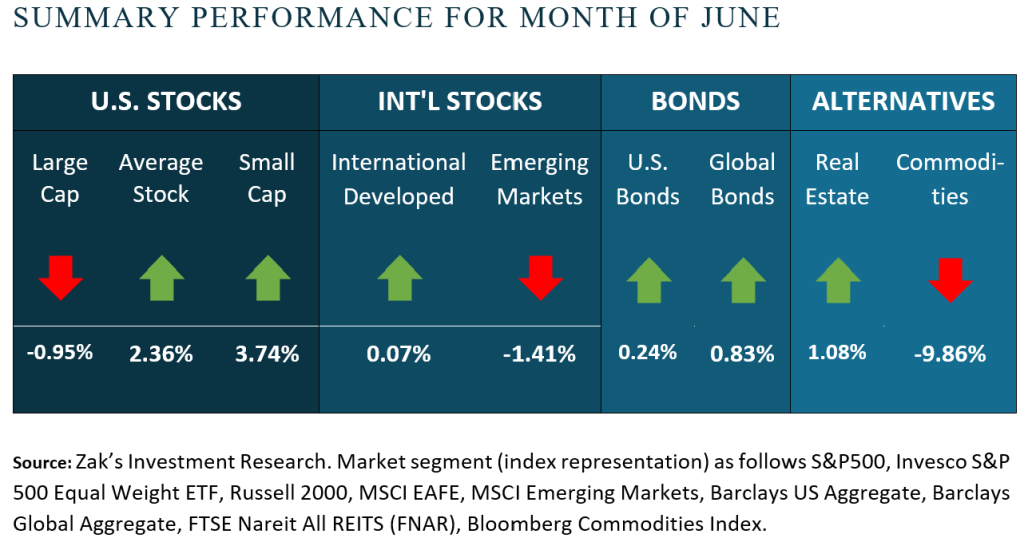
Commentary
June was another positive month for financial markets, driven largely by the announcement of a U.S.-Iran truce on June 12th. While the conflict had been gradually de-escalating throughout the spring, the formal agreement significantly reduced concerns over a broader regional conflict and the potential for prolonged disruptions to global energy markets. The announcement provided investors with greater confidence that one of the year's largest geopolitical risks was beginning to subside, allowing attention to shift back toward the underlying fundamentals of the U.S. economy and financial markets.
With geopolitical tensions easing, investors turned their attention back to the U.S. economy, where the data continued to send conflicting signals. The labor market remained resilient, with employers adding 172,000 jobs in May—more than double economists' expectations—while the unemployment rate held steady at 4.3%. At the same time, inflation continued to move higher, with the Consumer Price Index rising 4.2% on an annualized basis, remaining well above the Federal Reserve's long-term target. Consumer confidence also remained deeply depressed, as the University of Michigan's Consumer Sentiment Index held near record lows. Taken together, the data suggests an economy that continues to expand despite persistent inflationary pressures and a consumer that remains cautious about the economic outlook.
June also brought several noteworthy developments surrounding the Federal Reserve. Kevin Walsh presided over his first meeting as Chairman, where policymakers left interest rates unchanged while continuing to balance persistent inflation against a resilient labor market. A Supreme Court ruling blocking President Trump's attempt to remove Federal Reserve Governor Lisa Cook also reinforced the central bank's independence. Despite these headline events, the yield on the 10-year Treasury note ended June near where it began, suggesting investors remained focused on the outlook for inflation and economic growth rather than changes in leadership or political developments.
June reinforced an important lesson for investors: financial markets and the economy rarely move in lockstep. The S&P 500 reached its low in late March amid peak uncertainty surrounding the Middle East conflict, only to begin recovering as investors anticipated an eventual easing of tensions, well before a formal truce was announced. By June, much of the market's advance had already reflected improving expectations rather than simply reacting to the news itself. As always, successful investing requires looking beyond today's headlines and maintaining a disciplined, long-term perspective, recognizing that markets are constantly weighing not only current conditions but also the future they anticipate.we focus on fundamentals and maintain a disciplined, diversified approach with the goal of long-term wealth creation
Risk Numbers
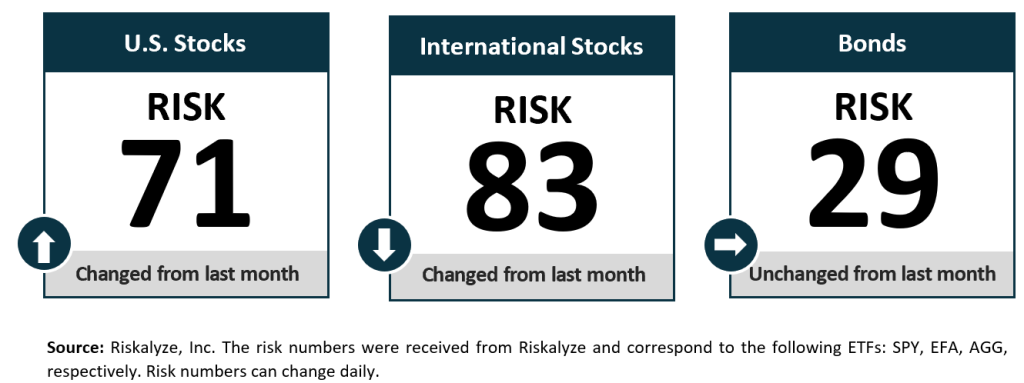
As of 07/06/2026
The Risk Number is at the heart of a sophisticated set of tools to precisely measure the appetite and capacity for risk that each client has and demonstrate their alignment with the portfolios built for them. The following graphic shows the risk of various asset classes as measured on a scale of 1-99 (1 being the most conservative and 99 being the most aggressive) as of the date above.
Centric's Approach
We start with a Risk Number, a measurable way to pinpoint how much risk you want, need, and already have. Then, your wealth advisor will optimally allocate our investments to help you reach your financial goals. Along the way, you will receive transparency of information, seamless proactive service and the trust and accountability you need to stay on track. All of this will lead to your personal comprehensive investment strategy that is powerful, disciplined, responsive.
Sources:
Centric’s Market Assumption Disclosures: This information is not intended as a recommendation to invest in any particular asset class or strategy or product or as a promise of future performance. Note that these asset class assumptions are passive, and do not consider the impact of active management. All estimates in this document are in US dollar terms unless noted otherwise. Given the complex risk-reward trade-offs involved, we advise clients to rely on their own judgment as well as quantitative optimization approaches in setting strategic allocations to all the asset classes and strategies. References to future returns are not promises or even estimates of actual returns a client portfolio may achieve. Assumptions, opinions and estimates are provided for illustrative purposes only. They should not be relied upon as recommendations to buy or sell securities. Forecasts of financial market trends that are based on current market conditions constitute our judgment and are subject to change without notice. We believe the information provided here is reliable, but do not warrant its accuracy or completeness. If the reader chooses to rely on the information, it is at its own risk. This material has been prepared for information purposes only and is not intended to provide, and should not be relied on for, accounting, legal, or tax advice. The outputs of the assumptions are provided for illustration purposes only and are subject to significant limitations. “Expected” return estimates are subject to uncertainty and error. Expected returns for each asset class can be conditional on economic scenarios; in the event a particular scenario comes to pass, actual returns could be significantly higher or lower than forecasted. Because of the inherent limitations of all models, potential investors should not rely exclusively on the model when making an investment decision. The model cannot account for the impact that economic, market, and other factors may have on the implementation and ongoing management of an actual investment portfolio. Unlike actual portfolio outcomes, the model outcomes do not reflect actual trading, liquidity constraints, fees, expenses, taxes and other factors that could impact future returns. Asset allocation/diversification does not guarantee investment returns and does not eliminate the risk of loss.
Index Disclosures: Index returns are for illustrative purposes only and do not represent any actual fund performance. Index performance returns do not reflect any management fees, transaction costs or expenses. Indices are unmanaged and one cannot invest directly in an index.
Riskalyze Disclosure: The Risk Number® is a proprietary scaled index developed by Riskalyze to reflect risk for both advisors and their clients. The Risk Number is at the heart of a sophisticated set of tools to precisely measure the appetite and capacity for risk that each client has, and demonstrate their alignment with the portfolios built for them.
Shaped like a speed limit sign, the Risk Number gives advisors and investors a common language to use when setting expectations, recognizing risk and making portfolio selections. Just like driving faster increases hazards, a higher Risk Number equates with higher levels of risk.
General disclosure: This material is intended for information purposes only, and does not constitute investment advice, a recommendation or an offer or solicitation to purchase or sell any securities to any person in any jurisdiction in which an offer, solicitation, purchase or sale would be unlawful under the securities laws of such jurisdiction. Reliance upon information in this material is at the sole discretion of the reader. Investing involves risks.
Get in Touch
Ready to take control of your finances and enjoy more of what matters in your life?