
by Richard Cull
May Market Recap and Commentary
Commentary
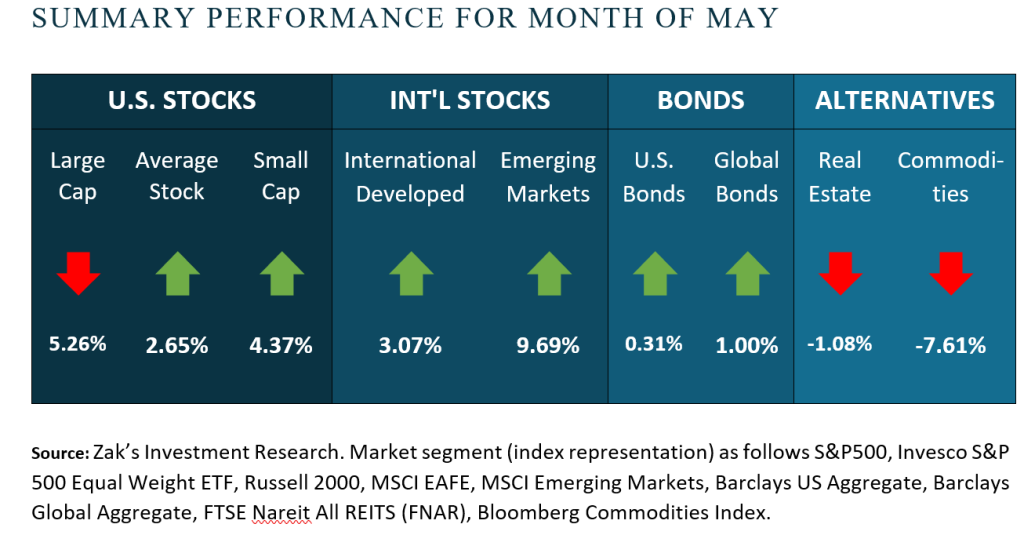
May was a second consecutive strong month for equity investors, extending the market rebound that began following the de-escalation of tensions in the Middle East earlier this spring. Beneath the surface, however, a different story was developing. Interest rates moved sharply higher throughout the month, creating a challenging environment for fixed income investors and raising new questions about inflation, economic growth, and the outlook for monetary policy.
The increase in interest rates reflected a growing tension within the economic outlook. While the labor market remained relatively stable, with employers adding 115,000 jobs in April and the unemployment rate holding steady at 4.3%, inflation continued to move higher. The Consumer Price Index rose to 3.8% on an annualized basis, extending the upward trend that began earlier in the spring. At the same time, concerns surrounding persistent federal budget deficits and the prospect of increased Treasury issuance added further pressure to bond markets. As a result, the yield on the 10-year Treasury note climbed from below 4% in March to as high as 4.68% in late May, contributing to a difficult month for fixed income investors.
Not all economic indicators pointed in the same direction. The University of Michigan's Survey of Consumer Sentiment fell to 44.8 in May, the lowest reading on record, reflecting growing concerns about inflation, borrowing costs, and the overall economic outlook. Historically, such depressed sentiment readings have often coincided with periods of economic weakness. However, consumer spending and labor market conditions have thus far proven more resilient than sentiment surveys alone would suggest. This divergence highlights the challenge investors face when interpreting economic data, as perceptions of economic conditions do not always translate immediately into changes in consumer behavior or broader economic activity.
Against this backdrop, the Federal Reserve entered a period of transition. Jerome Powell's term as Chair concluded during May, and Kevin Walsh was confirmed and sworn in as his successor. While leadership changes at the Fed often attract significant attention, the challenges facing policymakers remain largely unchanged. Inflation continues to run above the Fed's long-term target, while rising interest rates and weakening consumer sentiment suggest financial conditions are becoming more restrictive. For investors, the key question is not simply who leads the Federal Reserve, but how policymakers will balance the competing objectives of maintaining price stability while supporting continued economic growth.
May served as a reminder that financial markets and the economy do not always move in lockstep. While equity investors benefited from another month of strong returns, rising interest rates, persistent inflation, record-low consumer sentiment, and a transition in Federal Reserve leadership all point to a more complicated backdrop than headline market performance alone might suggest. As always, periods of uncertainty reinforce the importance of maintaining a disciplined, long-term investment approach rather than reacting to short-term market movements or economic headlines.
Risk Numbers
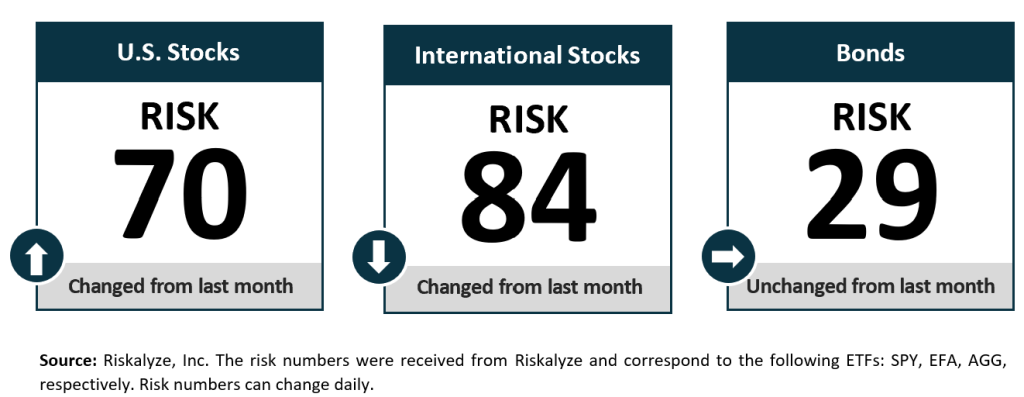
As of 06/06/2026
The Risk Number is at the heart of a sophisticated set of tools to precisely measure the appetite and capacity for risk that each client has and demonstrate their alignment with the portfolios built for them. The following graphic shows the risk of various asset classes as measured on a scale of 1-99 (1 being the most conservative and 99 being the most aggressive) as of the date above.
Centric's Approach
We start with a Risk Number, a measurable way to pinpoint how much risk you want, need, and already have. Then, your wealth advisor will optimally allocate our investments to help you reach your financial goals. Along the way, you will receive transparency of information, seamless proactive service and the trust and accountability you need to stay on track. All of this will lead to your personal comprehensive investment strategy that is powerful, disciplined, responsive.
Sources:
Centric’s Market Assumption Disclosures: This information is not intended as a recommendation to invest in any particular asset class or strategy or product or as a promise of future performance. Note that these asset class assumptions are passive, and do not consider the impact of active management. All estimates in this document are in US dollar terms unless noted otherwise. Given the complex risk-reward trade-offs involved, we advise clients to rely on their own judgment as well as quantitative optimization approaches in setting strategic allocations to all the asset classes and strategies. References to future returns are not promises or even estimates of actual returns a client portfolio may achieve. Assumptions, opinions and estimates are provided for illustrative purposes only. They should not be relied upon as recommendations to buy or sell securities. Forecasts of financial market trends that are based on current market conditions constitute our judgment and are subject to change without notice. We believe the information provided here is reliable, but do not warrant its accuracy or completeness. If the reader chooses to rely on the information, it is at its own risk. This material has been prepared for information purposes only and is not intended to provide, and should not be relied on for, accounting, legal, or tax advice. The outputs of the assumptions are provided for illustration purposes only and are subject to significant limitations. “Expected” return estimates are subject to uncertainty and error. Expected returns for each asset class can be conditional on economic scenarios; in the event a particular scenario comes to pass, actual returns could be significantly higher or lower than forecasted. Because of the inherent limitations of all models, potential investors should not rely exclusively on the model when making an investment decision. The model cannot account for the impact that economic, market, and other factors may have on the implementation and ongoing management of an actual investment portfolio. Unlike actual portfolio outcomes, the model outcomes do not reflect actual trading, liquidity constraints, fees, expenses, taxes and other factors that could impact future returns. Asset allocation/diversification does not guarantee investment returns and does not eliminate the risk of loss.
Index Disclosures: Index returns are for illustrative purposes only and do not represent any actual fund performance. Index performance returns do not reflect any management fees, transaction costs or expenses. Indices are unmanaged and one cannot invest directly in an index.
Riskalyze Disclosure: The Risk Number® is a proprietary scaled index developed by Riskalyze to reflect risk for both advisors and their clients. The Risk Number is at the heart of a sophisticated set of tools to precisely measure the appetite and capacity for risk that each client has, and demonstrate their alignment with the portfolios built for them.
Shaped like a speed limit sign, the Risk Number gives advisors and investors a common language to use when setting expectations, recognizing risk and making portfolio selections. Just like driving faster increases hazards, a higher Risk Number equates with higher levels of risk.
General disclosure: This material is intended for information purposes only, and does not constitute investment advice, a recommendation or an offer or solicitation to purchase or sell any securities to any person in any jurisdiction in which an offer, solicitation, purchase or sale would be unlawful under the securities laws of such jurisdiction. Reliance upon information in this material is at the sole discretion of the reader. Investing involves risks.
Get in Touch
Ready to take control of your finances and enjoy more of what matters in your life?